Welcome to Ambulocetus
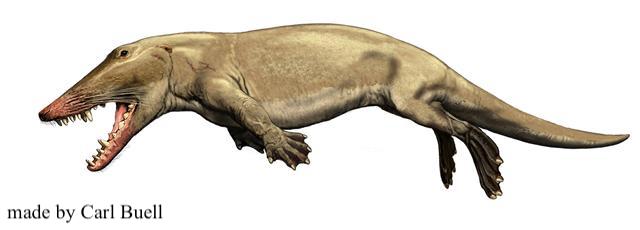
Name Definition
Walking whale
Name Given By
Hans Thewissen, Sayed Taseer Hussain, and Muhammad Arif in 1994
Location
Kuldana Formation in Pakistan, southern Asia
Classification
Mammalia, Ungulata, Artiodactyla, Cetacea, Archaeoceti, Ambulocetidae
Size
around 0.5 meters tall (1.6 ft), approximately 3 meters long (9.8 ft), anywhere between 150 - 300 kg (330 - 661 lbs)
Temporal Range
Lutetian - Ypresian stages of the Eocene epoch, approximately 48 - 47 million years ago
Ecological niche
mid-sized ambush predator
Species/Sub Species
A. natans
Diet
While it wasn’t the biggest predator, Ambulocetus would have still hunted large herbivores near water, amphibious mammals like sirenians (includes manatees and dugongs) and anthracobunids (rhino ancestors without the horns), while also hunting smaller prey such as fish and small reptiles if there was an opportunity
Introduction
Ambulocetus is a genus of ancestral carnivorous cetaceans that lived in Pakistan during the Eocene epoch of the Paleogene period. The generic name derives from the Latin word ambulare which means “to walk” and Greek word cetus which means “whale”, referring to the fact that it is an ancient whale ancestor while also being amphibious (amphibious means capable of living both in water and on land). The specific name, natans, means “swimming” in Latin in reference to the fact that Ambulocetus was a transitional form, so it would have started to swim like modern day cetaceans.
Ambulocetus is one of the most important mammalian finds as it fills in the gap between ungulate and whale evolution, making it a transitional form. Ambulocetus is known primarily from one skeleton that is around 80% complete, and due to its significance, it is one of the most well-known Eocene cetaceans. The holotype consists of an incomplete skull lacking the snout, fragments of the vertebral column and the ribs, and fragments of the forelimbs and hindlimbs. After the holotype was discovered in 1992, there have been several more specimens including a second and third premolar, a caudal vertebra, and the lower portion of a femur. Some further excavation recovered more of the holotype’s skeleton including a hip, a sacrum, as well as the ribcage and the thoracolumbar series (the spine but excludes the neck, sacrum, and tail). These new finds made the holotype 80% complete by 2002 and Ambulocetus remains one of the best-known cetaceans from the Eocene. In 2009, more elements of the jawbone from the holotype were discovered from a recently prepared matrix block.
Although it was already known that cetaceans descended from land mammals before Ambulocetus was discovered, the only evidence that the fossil record had then was the fully 52 million year old and fully terrestrial Pakicetus as well as the mesonychids from the Paleocene since it was hypothesized that there was a link between the mesonychids and cetaceans, and new limbs of Eocene cetaceans did not preserve well, not giving us a clear idea of the evolution. Ambulocetus helped show that before cetaceans gained their horizontal tail flukes, they swam in the water by flexing their spines up and down in a process called spinal undulation, meaning they swim up and down in a wave-like pattern flexing their spine up and down. Forelimb propulsion in cetaceans evolved rather late, which would mean that cetaceans went through an otter-like stage in evolution with spinal undulation and propulsion via the hindlimbs. This just shows how important Ambulocetus is in helping us understand the evolution of cetaceans, and the authors described Ambulocetus as “a critical intermediate between land mammals and aquatic cetaceans”.
Modern-day cetaceans are known as neocetes and are classified as odontocetes (predatory cetaceans with teeth) and mysticetes (baleen whales that filter feed). The Neoceti is descended from the Archaeoceti, with archaeocetes spanning the transition from land to water. Since archaeocetes do not include neocetes which are their descendants, Archaeoceti is paraphyletic (a group in taxonomy that doesn’t consist of the group’s most recent common ancestor and all the descendants). Ambulocetus was from the Archaeoceti since it is a transitional form between land ungulates and cetaceans.
The robust cheek teeth as well as the cusp arrangement in Ambulocetus were for crushing, and since the premolars and molars were both involved in crushing, Ambulocetus would have needed a large area in its mouth to crush in order to injure large prey animals. The broad and powerful snout also indicates that Ambulocetus wouldn’t have regularly hunted smaller and quick animals such as fish since that would require a more narrow snout like the modern day gharial. Plus, Ambulocetus also wouldn’t have the agility to pursue its prey, so it probably was an ambush predator. The eyes of Ambulocetus were placed on the top of its head, similar to modern-day crocodiles and other amphibious animals that stay submerged in water with their eyes peeking. The nasal canal would have also had bony walls and extended all the way to the throat so that it could consume prey underwater. This is also similar to crocodiles when they are drowning their prey or when they perform their infamous “death roll” in the water. Ambulocetus is thought to have been able to thrash its prey around like crocodiles in order to incapacitate its prey. Ambulocetus would have hunted animals near or in bodies of water it was living in such as ungulates, anthracobunids, and even the aquatic sirenians, the only two kinds of extant sirenians today being the manatee and the dugong. Though it didn’t have the agility, Ambulocetus would still go after fast fish or smaller reptiles if they had the opportunity. The ears of Ambulocetus are rather also interesting as they function better in water, further aiding it hunting in water for prey.
Isotope analysis of the holotype’s teeth show that Ambulocetus was exposed to both saltwater and freshwater, possibly meaning that it made itself home at a river mouth (the river mouth is the point where the river connects to a larger body of water, in this case a sea or ocean) where brackish water (mixture of saltwater and freshwater) was most abundant. Ambulocetus lived with the large amphibious ungulate Anthracobune, requiem sharks (livebearing and migratory sharks that live in relatively warm seas including the tiger shark and bull shark), a wide variety of fish including catfish, as well as other archaeocete cetaceans such as Gandakasia, Attokicetus, Nalacetus, and Pakicetus.